Product development
AI Can Draw a Perfect Tech Pack. But at What Cost?
An AI tech pack shows what a garment looks like, not how to make it. Here is what a factory still needs before it can quote and sample, and what the missing details cost you.
- Written by
- Hualingniao Apparel
- Category
- Product development
- Published
- Last updated
- Reading time
- About 8 min

On this page
- What does an AI tech pack get right, and what does it leave out?
- Why can't a factory quote from an AI image?
- The size chart is what stops sampling
- The colour on screen is brighter than any fabric
- A logo on a mockup has no size
- What does "everything custom" cost on a small first order?
- Example: a washed, printed hoodie below 200 pieces
- How do you turn an AI draft into a tech pack a factory can quote?
- What should you let AI do, and what should you check yourself?
- Frequently Asked Questions
- Can AI create a tech pack?
- What is a tech pack?
- How do I make my own tech pack?
- What is the best software for creating tech packs?
Article brief
Key takeaways
- 01A factory quotes decisions, not pictures: measurements, materials, artwork sizes, trims and quantity.
- 02Missing details turn into a padded quote, extra sample rounds or no reply at all.
- 03Custom packaging and special washes are fine, but each one adds cost on a small first order.
- 04Use AI for the draft; measure, size and choose trims yourself before you send it.
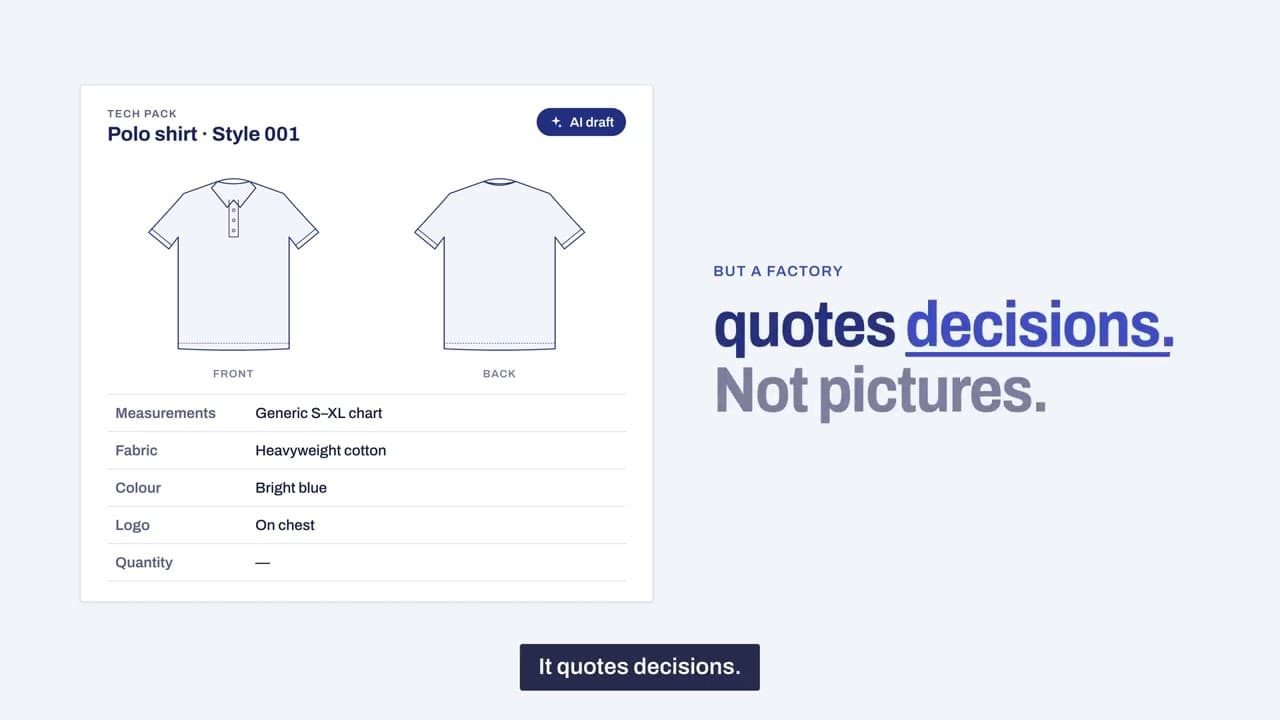
An AI tech pack can draw a garment in minutes, but a factory quotes and samples from decisions, not pictures: measurements, fabric, colour references, artwork sizes, trims and quantity. When those are missing, the factory has to guess, and every guess comes back as a padded quote, an extra sample round or no reply. Fill the gaps in our free tech pack template before you send it.
AI tools are genuinely good at the first draft. The problem is what the draft leaves out, and the fact that it looks finished enough that nobody notices until the quote arrives.
AI can generate a great clothing tech pack, but at what cost? · 1:06 · Watch on YouTube
Prefer to watch? This one-minute video covers what a factory still needs from an AI tech pack.
What does an AI tech pack get right, and what does it leave out?
Most AI-generated tech packs we receive look professional: clean flats, a colour render, a logo on the chest, a line about custom packaging. What they rarely contain is the information a pattern maker, fabric buyer and costing clerk need to do their jobs.
AI draft versus what the factory still needs
| Part | What an AI draft usually gives you | What the factory needs to quote and sample |
|---|---|---|
| Look | A photoreal render and front/back flats | Flats that match the garment you actually want made, with construction callouts |
| Measurements | A generic size chart, or none | Base-size points of measure, tolerances and grading for your size range |
| Fabric | "Heavyweight cotton" | Composition, construction, GSM and finish |
| Colour | Bright screen colours | A Pantone TCX reference for each part |
| Artwork | A logo pasted onto the mockup | A vector file, finished size in cm and placement from a fixed point |
| Trims and packaging | "Custom everything" | A bill of materials: each item, its material, size and whether it is stock or custom |
| Quantity | Often missing | Pieces per style, colour and size |
None of the right-hand column is hard. It just has to be decided by you, because the factory cannot decide it for your brand.
Why can't a factory quote from an AI image?
A garment price is built from parts: fabric consumption, labour time, decoration, trims, packaging and how many pieces share the development work. Each part depends on a decision in the tech pack. When the decision is missing, the factory can do one of three things:
- Assume the expensive option and quote high, so the price still holds when the real details arrive.
- Send back a list of questions, which adds days before you see a number.
- Skip the inquiry, because a quote built on guesses is likely to be rejected anyway.
None of these is what you wanted when you pressed "generate". Three gaps cause most of the delay.
The size chart is what stops sampling
Without points of measure, a pattern maker cannot cut a pattern. AI size charts are usually generic numbers that were never matched to your fit, so a boxy hoodie and a slim one get the same chest width. The fastest fix is to measure a garment you already like: lay it flat, measure chest width, body length, sleeve length, shoulder and hem, and use those as your base size. Our size chart converter helps you check the body measurements behind S to XL in each market.
The colour on screen is brighter than any fabric
A render is lit pixels. Fabric is dyed yarn. Many of the saturated colours in AI images cannot be reached on cotton fleece or jersey, and a screen colour is not a standard anyone can match. Pick a Pantone TCX reference for the body, rib, print and any trim, and expect the first lab dip to be a conversation, not a final answer.
A logo on a mockup has no size
"Logo on chest" is not production information. The print or embroidery workshop needs the vector file (.ai, .pdf or .svg), the finished width and height in centimetres, the placement measured from a fixed point such as the high point shoulder or centre front, the method and the ink or thread colours. If you are still choosing a method, our guide to DTF, screen printing and embroidery compares them for 50 to 500 piece orders.
What does "everything custom" cost on a small first order?
AI makes it free to draw a custom poly bag, a printed tissue wrap, a woven neck label, a leather patch, a branded zipper pull and a hang tag with a string lock. In production, every one of those is a separate component: its own material, artwork proof, supplier, lead time and approval. On a first order of 50 to 100 pieces, that work is spread across very few garments, so the price per piece climbs quickly.
We make woven and printed labels, hang tags and packaging from the first order through our private label service, so custom is possible. The question is which items your customer will actually notice.
- Custom first: the neck label and the hang tag, because customers see them on every garment.
- Standard first: poly bags, tissue, stickers and zipper pulls, which you can switch to custom on the reorder.
- List every item in the bill of materials and mark it "stock" or "custom", so the quote shows you what each choice adds.
Example: a washed, printed hoodie below 200 pieces
Some of the AI-generated inquiries we receive show a vintage-washed hoodie with a large faded print, often for 50 or 100 pieces. The render looks effortless. The production route is not.
Garment washing is done in batches by the partner wash houses we work with, not one garment at a time. Each wash shifts shade and shrinkage slightly, so the pattern has to allow for shrinkage, and the print has to be tested on washed fabric to see how it fades. A sample of that hoodie goes through the same wash trials as a bulk batch, which makes it far more expensive than a sample without a wash. Most buyers stop at the sample quote.
If your budget covers 50 to 100 pieces, launch the unwashed version of the design on our custom hoodie line to test demand, and add the wash when reorders justify 200 pieces per style.
How do you turn an AI draft into a tech pack a factory can quote?
Keep what the AI did well and replace the placeholders with your decisions. For the full list of sections, see what a factory-ready tech pack includes.
- Keep the flats, delete the guesses. Anything you have not decided, mark "open" instead of leaving an AI placeholder that reads like a spec.
- Measure a garment you like and write a base-size chart with points of measure and a tolerance for each.
- Write the bill of materials: main fabric with composition and GSM, rib, thread, zips, labels, hang tag and packaging, each marked stock or custom.
- Send artwork as vector files with the finished size in cm, placement, method and Pantone references.
- State the quantity per style, colour and size, plus your target price and launch date.
- Add a reference garment or photo if one exists. It answers questions a drawing cannot.
Our tech pack template is a free Excel download with seven sheets for exactly this: cover, sketch, bill of materials, measurements, construction, labels and colourways. There is no standard sample price, because every design is different. A plain sample with no logo is the cheapest; a T-shirt sample with a logo usually starts from about US$80, and each print, embroidery, wash or custom trim adds to it. What the filled template does is let us quote your sample exactly, and sampling takes 8 to 15 days once the details are confirmed, as set out on our sample development page.
What should you let AI do, and what should you check yourself?
Splitting the work between AI and you
| Task | Let AI draft it | Check or decide it yourself |
|---|---|---|
| Moodboard and design variants | Yes | Pick one direction before you ask for a quote |
| Front and back flats | Yes | Confirm seams, pockets and closures match what you want |
| Size chart | Only as a starting format | Measure real garments and set your base size |
| Fabric and GSM | As a shortlist | Choose composition and weight; ask for swatches |
| Colours | As a mood | Assign Pantone TCX references |
| Logo and print size | No | Set width, height and placement in cm |
| Trims and packaging | As a list of ideas | Decide stock or custom for each item |
| Care and content labels | No | Check the rules for the market you sell in |
Frequently Asked Questions
Can AI create a tech pack?
AI can create a tech pack draft: flats, a layout and a first list of materials. It cannot know your fit, your target cost or which trims you want to pay for, so measurements, artwork sizes, the bill of materials and quantities still need a person to decide and check before a factory can quote.
What is a tech pack?
A tech pack is the document a factory uses to quote, sample and repeat a garment: technical flats, measurements with tolerances, a bill of materials, colour and artwork references, construction notes and a revision log. Our guide to what a factory-ready tech pack includes walks through each section.
How do I make my own tech pack?
Start from a template, draw or reuse front and back flats, measure a garment whose fit you like for the size chart, list every material and trim in a bill of materials, add vector artwork with sizes and placement, and state quantities. A spreadsheet is enough for a first collection of 50 to 500 pieces per style.
What is the best software for creating tech packs?
For a small brand, a spreadsheet for measurements and the bill of materials plus a vector drawing tool for flats and artwork covers most needs. Dedicated tech pack or PLM software helps teams managing many styles and revisions, and AI generators help with first drafts. The factory cares about the content, not the software.
A perfect-looking tech pack is not the same as a finished one. Spend an hour turning the AI draft into decisions, and the quote you get back will be one you can actually plan with. When it is ready, send it to us.


