Custom manufacturing
Custom T-Shirts Manufacturer
Custom t-shirts cut from combed cotton jersey, built to your weight, fit and finish. Printing, embroidery and garment dye managed with your order. MOQ from 50 pieces.

Facts at a glance
- MOQ
- 50 pcs per style
- Sampling
- 8–15 days
- Bulk production
- 24–30 days after sample approval
- Fabrics
- Single jersey, slub jersey, interlock — combed cotton / cotton-spandex · 160–260 GSM
- Factory
- Dongguan (Humen), Guangdong, China · est. 2006
- Quality
- AQL 2.5 inline and final inspection · SGS on-site audited · Alibaba Verified Supplier · BSCI
- Scale
- 100 sewing-line workers · 300,000+ pieces per month
- Track record
- 10,000+ customers served in 70 countries since 2006
- Private label
- Woven and printed labels, hang tags and packaging from the first order
- Shipping
- EXW · FOB · DDP · worldwide
- Best for
- Emerging and scaling brands ordering 50–500 pieces per style
Hualingniao is a Dongguan cut-and-sew t-shirts manufacturer for emerging brands, founded in 2006: MOQ 50 pcs per style, samples in 8–15 days, bulk production in 24–30 days after sample approval, Single jersey, slub jersey, interlock — combed cotton / cotton-spandex in 160–260 GSM, private label from the first order, AQL 2.5 inspection with SGS on-site audited, Alibaba Verified Supplier and BSCI, a 100-worker sewing floor producing 300,000+ pieces a month for 10,000+ customers in 70 countries, EXW · FOB · DDP shipping worldwide.
Running styles in t-shirts
Reference styles from our current runs — order as-is, add your logo, or use them as a starting point for your own design.

Single Jersey Long Sleeve T-Shirt
Combed cotton single jersey
200 GSM
- MOQ
- 50 pcs per style
- Sample
- 8–15 days
- Printing
- Embroidery
- Wash & dye
- +2 more

Garment-Dyed Drop Shoulder T-Shirt
Combed cotton single jersey, garment dyed
240 GSM
- MOQ
- 50 pcs per style
- Sample
- 8–15 days
- Printing
- Embroidery
- Wash & dye
- +2 more

Combed Cotton Boxy Fit T-Shirt
Combed cotton single jersey
220 GSM
- MOQ
- 50 pcs per style
- Sample
- 8–15 days
- Printing
- Embroidery
- Wash & dye
- +2 more
Inside the factory
How are custom t-shirts made in our factory?
This 55-second video follows a custom t-shirt through our cut-and-sew factory in Dongguan, China, from a roll of combed cotton jersey to a folded, bagged tee ready to ship.
- Fabric check – each roll is inspected and tested for shrinkage and torque before it is cut.
- Cutting – panels are cut from patterns graded to your size chart.
- Sewing – each tee is assembled on our sewing lines.
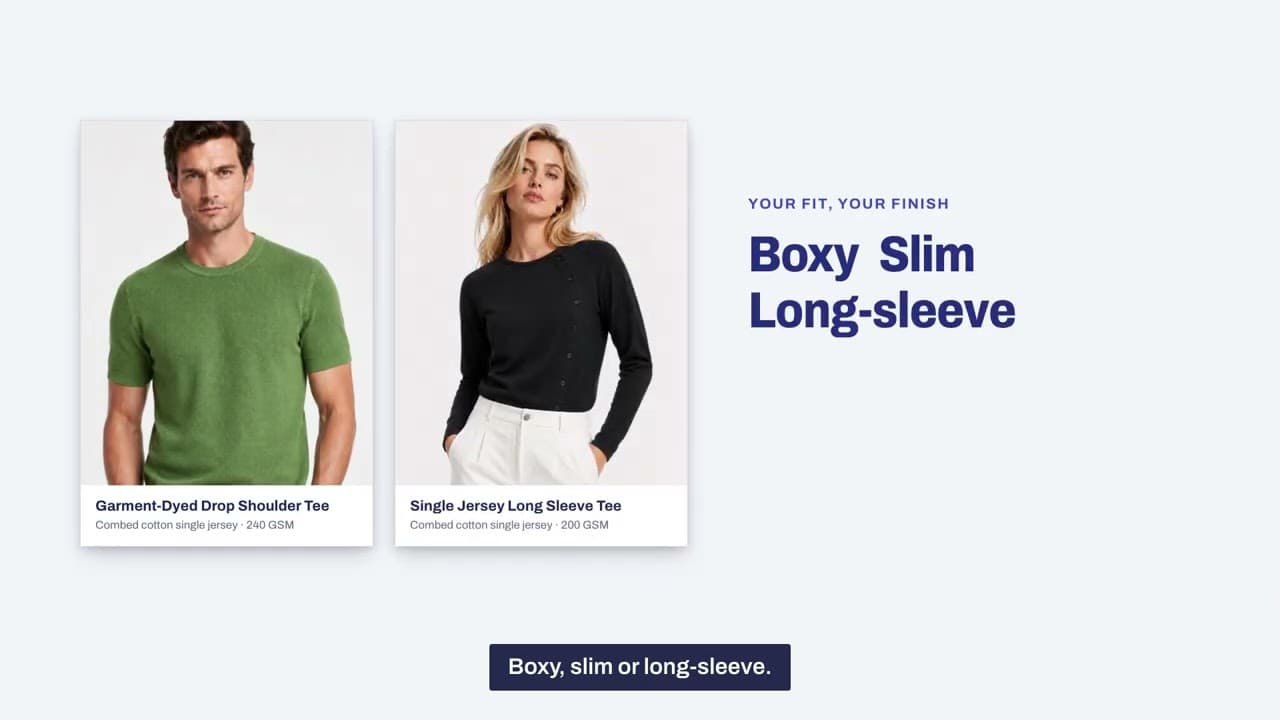
- Fit options – the same process runs boxy, slim and long-sleeve styles.
- Finishing – folded and bagged, ready to ship.
Specification
| Specification | Detail |
|---|---|
| Typical fabrics | Single jersey, slub jersey, interlock — combed cotton / cotton-spandex |
| Weight range | 160–260 GSM |
| MOQ | 50 pcs per style |
| Sample time | 8–15 days |
| Bulk lead time | 24–30 days after sample approval |
| Size range | XS–XXL · US / UK / EU / AU charts, or graded to your own |
US import code (HS): 6109.10 (cotton), 6109.90 (polyester) — codes and duty rates
Customization options
Silhouette and grading to your size chart Screen print, puff print, embroidery, rhinestones, heat transfer, appliqué Garment dye, acid wash and distressing Custom labels, hang tags and packaging
Ready to price your design?
Send a sketch, photo or tech pack — we reply with fabric options, a sample plan and a bulk estimate within 5 hours.
What kinds of t-shirts do we manufacture?
As a custom t-shirt manufacturer we cut and sew from roll fabric rather than decorating stock blanks, so the fit, weight and finish are yours from the first sample. Programs that run on our lines every month:
- Boxy and oversized tees in 220–260 GSM combed cotton — the streetwear staple, with drop shoulders and wide ribs
- Slim and regular fits in 160–200 GSM single jersey for fashion, uniform and promotional programs
- Long-sleeve tees, ringer tees and pocket tees built on the same blocks so a capsule shares one fit logic
- Garment-dyed, acid-washed and pigment-dyed tees where the colour is applied after sewing
- Blank tees for wholesale programs that decorate locally
The finished styles in our product catalog — a combed cotton boxy fit, a garment-dyed drop-shoulder tee and a single-jersey long sleeve — are the blocks most brands start from before adjusting length, sleeve and neck to their own spec.
Which fabrics and weights should you choose?
Weight decides how a tee hangs and how it survives washing. Our stocked range runs from 160 GSM for drapey summer fits to 260 GSM for structured boxy cuts, in single jersey, slub jersey and interlock, combed cotton or cotton-spandex. Every roll is checked for shrinkage and torque before cutting, because a jersey that twists 5% after washing turns a straight side seam into a spiral no customer forgives. The fabric weight guide explains how GSM, yarn count and knit structure interact if you are still deciding.
- 160–180 GSM single jersey — light, drapey, ideal for fashion and promotional volume
- 200–220 GSM combed cotton — the all-round weight for retail tees that hold shape
- 240–260 GSM heavyweight jersey — boxy streetwear silhouettes with a dense, dry hand
- Cotton-spandex and interlock — fitted tees and tanks that need recovery
If your reference is a competitor garment, send it: our fabric sourcing team matches construction and weight from running mill stock or develops a custom quality with lab dips against your Pantone reference.
Which construction details do we hold on every tee?
A t-shirt looks simple until you spec it. Collar rib recovery, shoulder tape, side-seam twist and hem shrinkage decide whether a customer reorders, so our tee blocks are pre-washed and measured after washing — the fit you approve is the fit that ships.
- 1x1 or 2x2 rib collars with elastane for recovery, taped back neck and shoulder seams as standard
- Tubular or side-seamed bodies to your preference; side seams are required for garment dye and boxy blocks
- Double-needle coverstitch hems, 2 cm or to spec; blind-stitch hems available for premium programs
- Graded to your size chart from XS to XXL, with plus-size grading on dedicated blocks
How do printing, embroidery and garment dye work?
Decoration is tested on the actual fabric before bulk — never assumed. Screen print, puff print, discharge, embroidery and heat transfer run through printing and embroidery partners we audit, with a strike-off on your sample so adhesion, hand-feel and placement are confirmed on the garment you will sell. Garment dye, acid wash and stone wash follow recorded recipes per style, so a reorder batch matches the first run instead of drifting a shade lighter.
Branding is finished in-house: woven or printed neck labels, tagless heat-transfer labels, hem tags, hangtags and individual poly bags or printed boxes through our private label service. A tee can leave the factory retail-ready, not just sewn.
Not sure which decoration method suits your order? Our guide to DTF vs screen printing vs embroidery compares the three for bulk runs of 50–500 pieces.
What are the MOQ, sample time and lead time?
MOQ is 50 pieces per style, mixed across sizes and, for most fabrics, across two or three colours. Samples take 8–15 days through sample development and bulk ships 24–30 days after sample approval. Both figures are the ones we quote, not marketing numbers: they assume fabric in stock or reserved and artwork approved. Custom-dyed fabric adds roughly a week. The MOQ guide explains how minimums are built up from fabric, dye lots and decoration setups.
Which quality checks run before a tee ships?
- Fabric: shrinkage, torque and colour-fastness tested per lot before cutting
- Sewing: collar rib stretch and recovery, shoulder tape, coverstitch skip-stitch check on every bundle
- Measurement: 100% of the size-set sample and AQL 2.5 sampling on bulk against your measurement sheet
- Finishing: print adhesion after wash test, label placement and packing spec verified at final inspection
How do you start a custom t-shirt program with us?
Send a tech pack, or a reference tee with notes on what should change — our tech pack guide lists what the sample room actually needs. We reply within five hours with fabric options, a sample plan and a bulk estimate against your quantity and destination. From there: fabric approval, sample, one or two revision rounds, then bulk with inline and final inspection against your measurement sheet.
Tees are the entry point for most capsules. Pair them with hoodies, shorts or tank tops cut from matching dye lots, and the whole drop gets one fit and colour approval. Caps and custom socks round out a merch drop. Our size chart converter shows the body measurements behind each size. Request a quote to start.
FAQ
Questions buyers ask about custom t-shirts
What is the minimum order quantity for custom t-shirts?
The MOQ is 50 pieces per style. You can split those 50 pieces across sizes, and across colours where the fabric is a running stock quality. There is no minimum on the number of styles in an order.
Which fabric weight should I choose for my t-shirts?
We run combed cotton single jersey, slub jersey, interlock and cotton-spandex from 160 to 260 GSM. 160–180 GSM suits lightweight fashion tees, 200–220 GSM is the standard premium weight, and 240–260 GSM gives the heavyweight, boxy streetwear hand-feel.
How long does a t-shirt sample take, and what do you need from me?
A sample takes 8–15 days. Send a tech pack or a reference garment plus your size chart (US, UK, EU or AU — or your own measurements). We make a fit sample first, then a pre-production sample in the approved fabric and colour.
What printing and branding options are available on t-shirts?
Screen print, puff print, embroidery, rhinestones, heat transfer and appliqué, plus garment dye, acid wash and distressing. Woven or printed labels, hang tags and custom packaging are included from the first order — private label is standard, not an upgrade.
What is the bulk lead time for t-shirts, and how are they shipped?
Bulk production takes 24–30 days after sample approval, with AQL 2.5 inline and final inspection before packing. We ship worldwide on EXW, FOB or DDP terms, agreed with your quote.
Start your production run
Start your custom t-shirts order
Send a tech pack or a reference sample. We reply with fabric options, a sample plan and a bulk estimate within 5 hours.