Tech pack template
Free clothing tech pack template — Excel & PDF download
A garment tech pack is the document an apparel factory prices and cuts from: the style, its materials, every measurement, every seam and every label. Download our template, fill in what you know, delete what you don’t, and send it with your inquiry.
Free, no email required. The Excel file has seven sheets to fill in; the PDF is the same structure, for printing or marking up by hand.
Filled it in? Get it priced.
Attach your tech pack to a quote request with quantity and destination. We reply with a costed quote and a sample plan, usually within five hours.
Send your tech pack for a quote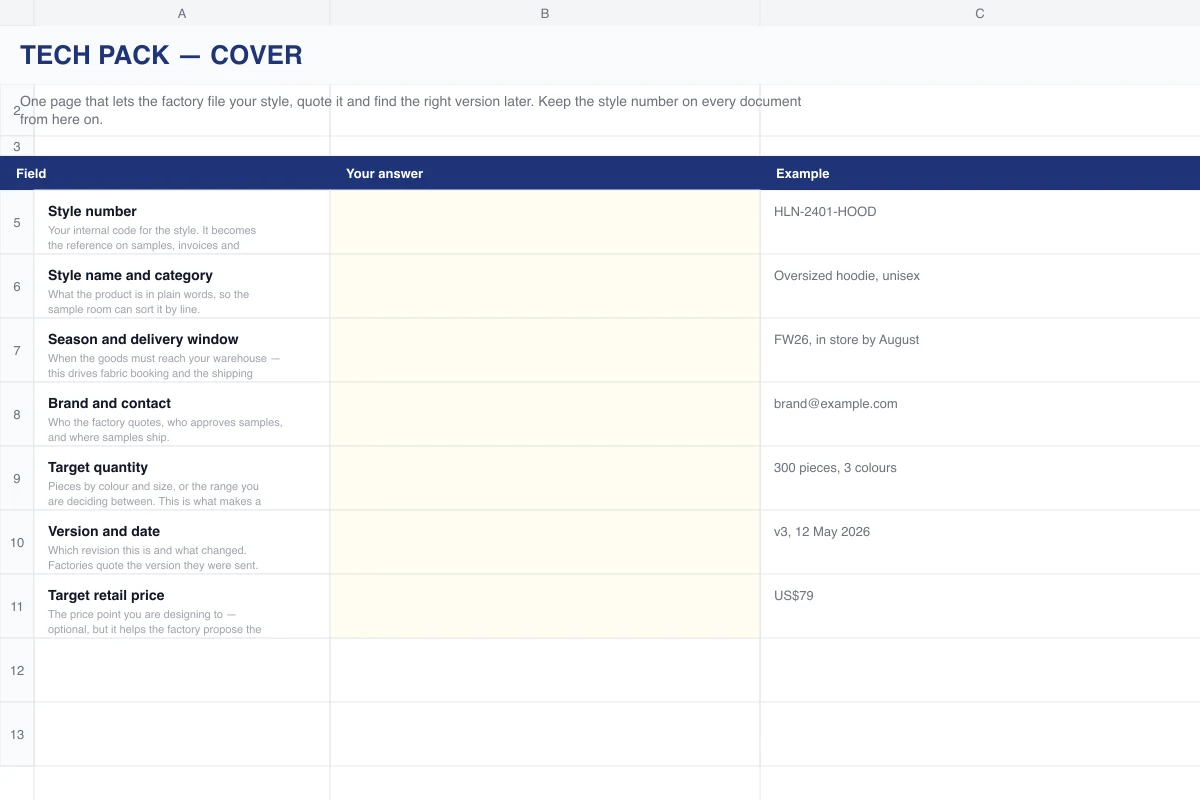
What’s inside
Every sheet in the template
Seven sheets cover what a sample room and a sewing line need from a first inquiry. Skip any sheet that does not apply — a clean partial tech pack beats an empty full one.
Cover — the style, identified
One page that lets the factory file your style, quote it and find the right version later. Keep the style number on every document from here on.
| Field | What to put in it | Example |
|---|---|---|
| Style number | Your internal code for the style. It becomes the reference on samples, invoices and cartons. | HLN-2401-HOOD |
| Style name and category | What the product is in plain words, so the sample room can sort it by line. | Oversized hoodie, unisex |
| Season and delivery window | When the goods must reach your warehouse — this drives fabric booking and the shipping mode. | FW26, in store by August |
| Brand and contact | Who the factory quotes, who approves samples, and where samples ship. | brand@example.com |
| Target quantity | Pieces by colour and size, or the range you are deciding between. This is what makes a quote real. | 300 pieces, 3 colours |
| Version and date | Which revision this is and what changed. Factories quote the version they were sent. | v3, 12 May 2026 |
| Target retail price | The price point you are designing to — optional, but it helps the factory propose the right fabric and construction. | US$79 |
Sketch — what it looks like
Pictures remove more misunderstandings than any paragraph. A flat drawing, a marked-up photo or a physical reference all work; the notes around them are what make them useful.
| Field | What to put in it | Example |
|---|---|---|
| Front view | A flat sketch, a clean photo or a marked-up screenshot. Mark seams, pockets, closures and panel breaks. | flat-front.png |
| Back view | Same treatment. Note any back print, yoke seam or panel split. | flat-back.png |
| Numbered callouts | Number every detail on the sketch; explain each number once on the Construction sheet. | 1: lined hood |
| Reference garments | Photos of a product you own, with what to copy and what to change. Often faster than a drawing. | Fits like this, 4 cm longer |
| Point-of-measure lines | Optional lines showing where each measurement is taken, keyed to the Measurements sheet. | A, B, C |
BOM — every material, line by line
The bill of materials is where price is made. List each part separately — body fabric, rib, trims, labels, packaging — with the columns below. Consumption per piece and colour references are what let a mill quote the same thing twice.
| Field | What to put in it | Example |
|---|---|---|
| Part | Where the material goes: body, hood, cuffs, pocket lining, drawcord. | Body |
| Material | The trade name, so the factory can propose an equivalent if yours is unavailable. | French terry |
| Composition | Fibre percentages. Drives price, hand feel and most of the duty rate. | 80% cotton / 20% polyester |
| Weight | Grams per square metre — convert your oz/yd² figures first. | 320 GSM |
| Colour | A Pantone reference or “match to swatch”. Note where the body and trims differ. | Pantone 19-4024 TPX |
| Supplier or reference | Your supplier, an existing fabric code or a physical swatch you will courier. | swatch sent 12 May |
| Consumption | Metres or kilograms per piece including wastage. We verify it, but a starting figure speeds up costing. | 1.4 m per piece |
| Notes | Finish, shrinkage, stretch direction, test requirements, minimum per colour. | Enzyme wash, max 5% shrinkage |
Measurements — the size set, point by point
A garment is inspected against this sheet, so it has to be unambiguous. One row per measurement, one column per size, and a tolerance — this is the sheet that prevents a shipment being rejected over a 1 cm difference.
| Field | What to put in it | Example |
|---|---|---|
| Points of measure | One row per point: chest width, body length, shoulder, sleeve, hem, cuff, hood opening, pocket placement. | Chest width |
| How each point is measured | One sentence per point, e.g. “chest width: 2.5 cm below the armhole, laid flat, edge to edge”. | 2.5 cm below armhole, edge to edge |
| Size columns | XS to XXL, or the size set you actually sell. Add columns rather than approximating. | XS–XXL |
| Tolerance | The acceptable difference per point — ±1 cm on knitwear is common. Without it nothing can be inspected. | ±1 cm |
| Unit | Centimetres are the factory standard. Inches are fine if the column is labelled. | cm |
| Sample vs bulk | Record which pattern version and sample round the sheet describes. | approved sample, round 2 |
Construction — how it is sewn
This sheet is where a good sample becomes a repeatable order. Describe the stitches, seams, thread and decoration exactly; anything left vague will be decided by whoever is on the machine.
| Field | What to put in it | Example |
|---|---|---|
| Stitch type and density | For example single-needle lockstitch at 12 stitches per inch, overlock at 4–5 mm. | SNLS 12 SPI |
| Seam type and finish | Flatlock, overlock, taped shoulder-to-shoulder, French seams. A photo of a seam you like helps. | Taped shoulders |
| Thread | Thread type and colour: match the body or use a contrast. | Tex 30, match body |
| Print position and size | Placement, width × height, number of colours and the artwork file. Name the method if you care about it. | Front, 28 × 20 cm, 3 colours |
| Embroidery position and stitches | Placement, size and approximate stitch count per logo — stitch count is a cost driver. | Left chest, ~4,500 stitches |
| Hardware | Zipper type and length, drawcords, eyelets, snaps; colour and any test requirement. | YKK #5, nickel-free |
| Topstitching | Width and colour of visible stitching — a small detail that changes the look. | 2 mm, tonal |
Labels and packaging — what ships with it
Private label lives here: the trims and print that carry your brand, and the carton the goods arrive in.
| Field | What to put in it | Example |
|---|---|---|
| Main label | Woven or printed, where it sits (usually centre back neck) and how it is attached. | Woven, centre back |
| Care label | Fibre content, care symbols and the languages your market requires. | EN/ES/FR, side seam |
| Hang tag | Size, material, attachment and whether a price is printed. | Matte card, black cord |
| Fold and polybag | How the garment is folded, bag type, size sticker and any suffocation warning. | Tissue wrap, recycled PE bag |
| Barcode or stickers | Your SKU barcode, EAN/UPC or retail-specific labels — send the files. | UPC-A |
| Carton packing | Pieces per carton, size and colour ratio, carton size and weight, shipping marks. | 50 pcs, assorted sizes |
Colorways — the colour plan
Colour is the most common cause of a bulk-fabric surprise. Name every colour, reference it to something physical and say how many pieces each one carries.
| Field | What to put in it | Example |
|---|---|---|
| Colour name | The name you sell under. Keep it stable between sample and bulk. | Sea Green |
| Colour reference | Pantone TCX/TPX, a lab-dip reference or “match to sample”. Approve the lab dip before the dye lot. | Pantone 17-5117 TPX |
| Quantity per colour | How many pieces per colour. Below a fabric minimum, two colours may share a lot or carry a surcharge. | 120 / 100 / 80 |
| Size breakdown | How many of each size per colour — this sets fabric consumption and packing. | S–XXL, 20% / 30% / 30% / 20% |
| Trim matching | Which trims change colour with the body and which stay neutral. | Rib and drawcord tonal |
| Repeats and heroes | Say which colour is expected to sell and whether a reorder is planned; it helps fabric booking. | Sea Green is the hero |
No tech pack yet? Send a reference sample instead
Plenty of first orders start from a garment you already own or a photo of one. Courier us the reference with a note on what to change — fit, weight, colour, length — and our pattern team works from it. A tech pack speeds up the first quote; it is not a condition for ordering.
Keep reading
Start your production run
Send the tech pack — or the reference sample
Whatever you have, send it with quantity and destination. We reply with a costed quote and a sample plan, usually within five hours.